

The social calculus of exiting “Close Friends” territory
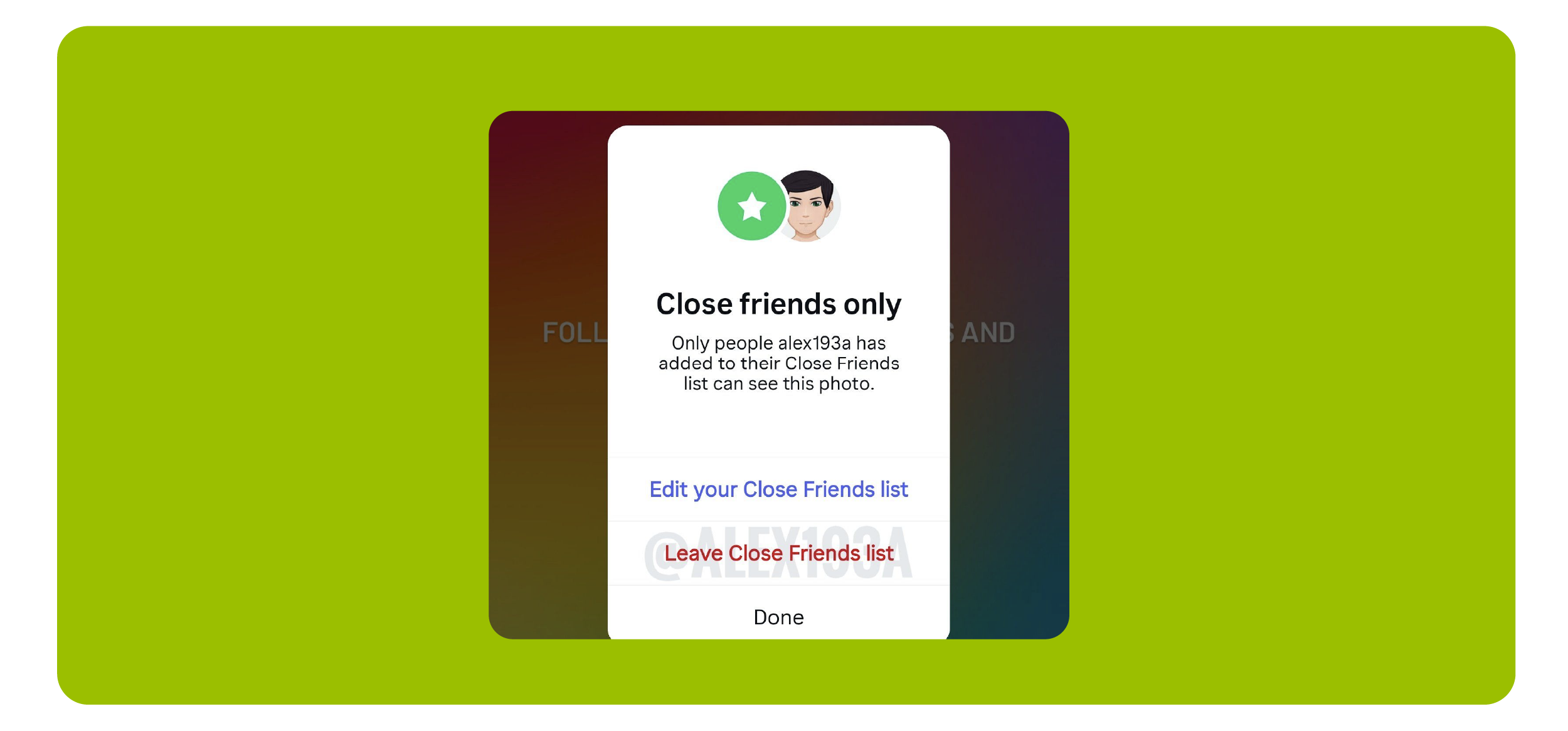
Instagram is developing a way for users to remove themselves from other people’s “Close Friends” lists.
Since “Close Friends” launched in 2018, it has operated on a fundamentally asymmetrical power dynamic: the list creator has all the control, and those on the list are just passive recipients of whatever content gets deemed “close friends worthy.” Close Friends evolved into something far beyond its original purpose. It started as a way to share more authentic, less polished content with people you actually care about.
Instagram’s solution? Let you leave, opt out, hit the eject button on someone’s curated inner circle. According to screenshots from reverse engineer Alessandro Paluzzi, Meta will notify users that leaving a Close Friends list means you won’t see that person’s Close Friends content unless they re-add you.
Social media has spent years prioritizing engagement over boundaries, connection over consent. The assumption has always been that more sharing is better, that access is a gift, and that declining that gift is rude. Instagram’s new feature challenges this by letting you opt out of intimacy you didn’t ask for.
Snapchat did it first, letting users to remove themselves from private stories for years; the platform has always been slightly better at understanding ephemeral intimacy and the need for reciprocal consent in sharing.
Instagram, on the other hand, has spent years optimizing for maximum engagement and minimum friction. Every feature is designed to keep you in, keep you watching, keep you connected. A feature that explicitly lets you disconnect? That’s uncharted territory.
To learn more, click here.